{{#widget:Qwant}}
« Crp:Food cooking and health » : différence entre les versions
Aucun résumé des modifications |
Aucun résumé des modifications |
||
| Ligne 12 : | Ligne 12 : | ||
'''About the book…''' | '''About the book…''' | ||
Given recent global crises, the imperative to preserve and analyse online content has never been more vital to enhancing our comprehension of contemporary changes. This book, the outcome of the 5th international RESAW conference that convened experts from fifty disciplines across seventeen countries in Marseille in June 2023, tackles the multifaceted challenges of web archiving. It underscores the dual roles of web archiving, as cultural heritage and as essential source material for researchers delving into contemporary events and the evolution of digital culture. Through twenty chapters, it explores the development of web archiving and examines how technical, cultural, geopolitical, societal, and environmental shifts impact its conception, study, and dissemination. | |||
Keywords: Web archiving, Contemporary changes, Cultural heritage, Digital culture, Geopolitical shifts | |||
About the chapter | |||
Based on a collaborative effort between the research project BodyCapital and the Bibliothèque Nationale de France (BnF), we present a two-step archiving process and analysis of audiovisual web content related to food and health history, investigating how audiovisuals have contributed to shaping our eating habits. The first step involved a web crawl with Heritrix, targeting 158 identified seed URLs compiled based on BnF science & technology lists and URLs identified by the research group. The crawl harvested 1,067,159 URLs. A content analysis identified 1,718 videos in our corpus. Content mapping and the identification of links to YouTube videos were performed, leading to the second step involving a focused collection of 34 YouTube channels harvesting 24,427 videos (2.4 TB) to be analysed.. | |||
fmalaria.png|[[Feind Malaria|Feind Malaria (Allemagne, 1943)]]|link=[[Feind Malaria]] | fmalaria.png|[[Feind Malaria|Feind Malaria (Allemagne, 1943)]]|link=[[Feind Malaria]] | ||
funincamp.png|[[Fun in camp|Fun in camp (USA, 1899)]]|link=[[Fun in camp]] | funincamp.png|[[Fun in camp|Fun in camp (USA, 1899)]]|link=[[Fun in camp]] | ||
| Ligne 59 : | Ligne 56 : | ||
EDITORS: Christian Bonah is a professor of history and health and life sciences at the University of Strasbourg. David Cantor is a historian at the National Institutes of Health and the University of Maryland. Anja Laukötter is a researcher at the Center for the History of Emotions at Max-Planck-Institute for Human Development. | EDITORS: Christian Bonah is a professor of history and health and life sciences at the University of Strasbourg. David Cantor is a historian at the National Institutes of Health and the University of Maryland. Anja Laukötter is a researcher at the Center for the History of Emotions at Max-Planck-Institute for Human Development. | ||
About the authors | |||
Christian Bonah (https://sage.unistra.fr/el/membres/enseignants-chercheurs/bonah-christian/) is professor for the history of health and life sciences at the University of Strasbourg. Member of Institut Universitaire de France (2005-2010) and ERC Advanced Grant laureate he is directing the department for medical humanities at the Medical Faculty Strasbourg. He has worked on comparative history of medical education, the history of medicaments, as well as the history of human experimentation. Recent work includes research on risk perception and management in drug scandals as well as studies on medical information and communication through audiovisuals. At the present he is the principle investigator of the PRCI Grant ArchiMed : Mining medical archives and pathological collections in the digital age. Artificial intelligence at the frontiers of biology and the humanities. | |||
Solène Lellinger (lien vers site personel : https://solenelellinger.com) is assistant professor in History and Philosophy of Health in medicine faculty at Université Paris Cité. Her research focuses on the socio-history of therapeutic agents, which she studies through their production, regulation and use in care relationships. She’s also interested in medical scandals, medicine and medical practice in 20th century, production of scientific knowledge, victims of therapeutic injuries and the forms of their mobilizations, medical expertise, and ways of influences (especially conflicts of interest). | |||
<small>'''Acknowledgement:''' MedFilm and University of Rochester Press gratefully acknowledge generous support from the Brocher Foundation, Switzerland.</small> | <small>'''Acknowledgement:''' MedFilm and University of Rochester Press gratefully acknowledge generous support from the Brocher Foundation, Switzerland.</small> | ||
[[Image:Urp_logo_380x72_1.jpg|360px|link=https://boydellandbrewer.com/health-education-films-in-the-twentieth-century.html]] | [[Image:Urp_logo_380x72_1.jpg|360px|link=https://boydellandbrewer.com/health-education-films-in-the-twentieth-century.html]] | ||
Version du 10 octobre 2024 à 13:15
PAGE MODÈLE À MODIFIER
Companion website to
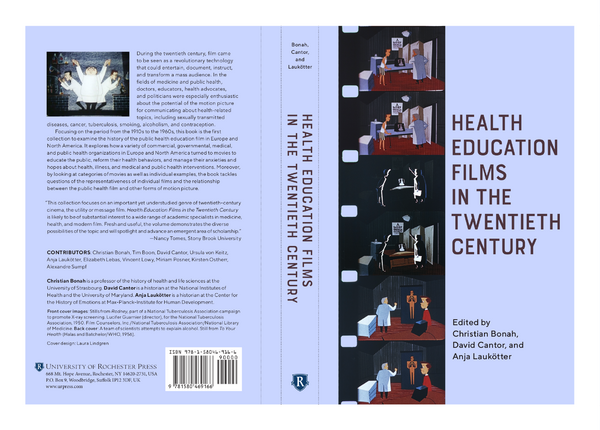
Health Education Films in the Twentieth Century
Christian Bonah, David Cantor, and Anja Laukötter (eds.), Health Education Films in the Twentieth Century, Rochester, NY: Rochester University Press, 2018,
About the book… Given recent global crises, the imperative to preserve and analyse online content has never been more vital to enhancing our comprehension of contemporary changes. This book, the outcome of the 5th international RESAW conference that convened experts from fifty disciplines across seventeen countries in Marseille in June 2023, tackles the multifaceted challenges of web archiving. It underscores the dual roles of web archiving, as cultural heritage and as essential source material for researchers delving into contemporary events and the evolution of digital culture. Through twenty chapters, it explores the development of web archiving and examines how technical, cultural, geopolitical, societal, and environmental shifts impact its conception, study, and dissemination.
Keywords: Web archiving, Contemporary changes, Cultural heritage, Digital culture, Geopolitical shifts
About the chapter Based on a collaborative effort between the research project BodyCapital and the Bibliothèque Nationale de France (BnF), we present a two-step archiving process and analysis of audiovisual web content related to food and health history, investigating how audiovisuals have contributed to shaping our eating habits. The first step involved a web crawl with Heritrix, targeting 158 identified seed URLs compiled based on BnF science & technology lists and URLs identified by the research group. The crawl harvested 1,067,159 URLs. A content analysis identified 1,718 videos in our corpus. Content mapping and the identification of links to YouTube videos were performed, leading to the second step involving a focused collection of 34 YouTube channels harvesting 24,427 videos (2.4 TB) to be analysed..
fmalaria.png|Feind Malaria (Allemagne, 1943)|link=Feind Malaria
funincamp.png|Fun in camp (USA, 1899)|link=Fun in camp
hemo.png|Hemo the Magnificent (USA, 1957)|link=Hemo the Magnificent
sepsis.png|Hospital sepsis (USA, 1959)|link=Hospital sepsis
jimmy.png|How Jimmy won the game (USA, 1928)|link=How Jimmy won the game
service.png|In the service of Humanity (Allemagne, 1938)|link=In the service of Humanity
let my people live.png|Let my people live (USA, 1938)|link=Let my people live
let there be the light.png|Let there be light (USA, 1946)|link=Let there be light
liferescue.png|Life rescue at Long Branch (USA, 1901)|link=Life rescue at Long Branch
lonegame.png|The Lone Game (USA, 1915)|link=The Lone Game
loveandwar.png|Love and war (USA, 1899)|link=Love and war
malaria.png|Malaria (Allemagne, 1934)|link=Malaria_(2)
manalive35.png|Man alive (USA, 1952)|link=Man_alive
redcross.png|Red Cross ambulance on battlefield (USA, 1900)|link=Red Cross ambulance on battlefield
courage.png|The Reward of Courage (USA, 1921)|link=The Reward of Courage
Devil.png|La Roue du diable (Russie, 1926)|link=La Roue du diable
saba.png|Saba (Russie, 1929)|link=Saba
Sandow.png|Sandow (USA, 1894)|link=Sandow
Sexhygiene.png|Sex hygiene (USA, 1941)|link=Sex hygiene
stobhill.png|Stobhill Hospital (Royaume Uni)|link=Stobhill Hospital
la tenancière.png|Tanka la tenancière (Russie, 1929)|link=Tanka_la_tenancière
Wendy.png|The story of Wendy Hill (USA, 1949)|link=The_story_of_Wendy_Hill
moloch.png|The Temple of Moloch (USA, 1914)|link=The Temple of Moloch
yourhealth.png|To Your Health (USA, 1956)|link=To Your Health
troops.png|U.S. troops and Red Cross (USA, 1899)|link=U.S. troops and Red Cross in the trenches before Caloocan
</gallery>
This companion website to the book provides access to a selection of films discussed in the chapters of the book. The companion website has been created by the research project MedFilm at the University of Strasbourg.

About the authors…
EDITORS: Christian Bonah is a professor of history and health and life sciences at the University of Strasbourg. David Cantor is a historian at the National Institutes of Health and the University of Maryland. Anja Laukötter is a researcher at the Center for the History of Emotions at Max-Planck-Institute for Human Development.
About the authors
Christian Bonah (https://sage.unistra.fr/el/membres/enseignants-chercheurs/bonah-christian/) is professor for the history of health and life sciences at the University of Strasbourg. Member of Institut Universitaire de France (2005-2010) and ERC Advanced Grant laureate he is directing the department for medical humanities at the Medical Faculty Strasbourg. He has worked on comparative history of medical education, the history of medicaments, as well as the history of human experimentation. Recent work includes research on risk perception and management in drug scandals as well as studies on medical information and communication through audiovisuals. At the present he is the principle investigator of the PRCI Grant ArchiMed : Mining medical archives and pathological collections in the digital age. Artificial intelligence at the frontiers of biology and the humanities.
Solène Lellinger (lien vers site personel : https://solenelellinger.com) is assistant professor in History and Philosophy of Health in medicine faculty at Université Paris Cité. Her research focuses on the socio-history of therapeutic agents, which she studies through their production, regulation and use in care relationships. She’s also interested in medical scandals, medicine and medical practice in 20th century, production of scientific knowledge, victims of therapeutic injuries and the forms of their mobilizations, medical expertise, and ways of influences (especially conflicts of interest).
Acknowledgement: MedFilm and University of Rochester Press gratefully acknowledge generous support from the Brocher Foundation, Switzerland.


