{{#widget:Qwant}}
Health Education Films in the Twentieth Century
En étudiant les représentations des relations de soins dans les films éducatifs français des années 50 jusqu’aux années 90, nous observons que certains films entreprennent de sensibiliser à l’expérience propre du patient. Il s’agit d’un « cinéma de compassion » qui accompagne la personne malade lorsque, retournant à son espace-temps personnel, elle se tient hors de portée de l’observation médicale.
Références Medfilm :
- Des enfants comme les autres (1955) Archives Sorbonne Nouvelle-CCEP
- Un médecin de campagne (1959) Archives Sorbonne Nouvelle-CCEP
- Le monde du schizophrène (1961) Archives CIL-Image'Est
- Rhumatologie et relation médecin-malade (1976) Archives CIL-Image'Est
- Sur les traces de Balint (1976) Archives CIL-Image'Est
- Autoportrait d’un Schizophrène (1976) Archives CIL-Image'Est
- Témoignages sur la trithérapie (1998) Archives CIRDD
Crp:Maladiesinfectieuses
Bonah, Christian et Danet, Joël (2020). « Fighting the Uncertainty of Tomorrow : Explaining and Portraying the Social Security System on French Television for Schools ». VIEW Journal of European Television History and Culture [en ligne]. 24 décembre 2020. Vol. 9, n° 18, 96. (https://www.viewjournal.eu/articles/10.18146/view.227/)
Les programmes télévisés éducatifs pour les écoles, produits entre les années 1950 et 1980, traitent régulièrement du système de protection sociale français. Nous étudions ici comment ces leurs mises en scène ont contribué à éveiller les élèves des écoles, considérés comme jeunes citoyens, à la vocation et aux modalités de l'administration de la sécurité sociale.

Références Medfilm :
- ''Sécurité sociale '' (1957), archives Canopé
- ''La journée d’un médecin '' (1967), archives Canopé
- ''La sécurité sociale '' (1969), archives Canopé
- ''Questions de solidarité '' (1982), archives Canopé
Crp:Autop
Crp:Psykopf
Crp:Trem
Crp:Child
Crp:Chir
Crp:Anthropo
Crp:Gesn
Crp:Neuropsychiatrie
Crp:SHSWeb
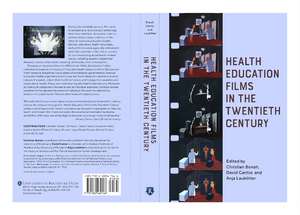
About the book… During the twentieth century, film came to be seen as a revolutionary technology that could entertain, document, instruct, and transform a mass audience. In the fields of medicine and public health, doctors, educators, health advocates, and politicians were especially enthusiastic about the potential of the motion picture for communicating about health-related topics, including sexually transmitted diseases, cancer, tuberculosis, smoking, alcoholism, and contraception.
Focusing on the period from the 1910s to the 1960s, this book is the first collection to examine the history of the public health education film in Europe and North America. It explores how a variety of commercial, governmental, medical, and public health organizations in Europe and North America turned to movies to educate the public, reform their health behaviors, and manage their anxieties and hopes about health, illness, and medical and public health interventions. Moreover, by looking at categories of movies as well as individual examples, the book tackles questions of the representativeness of individual films and the relationship between the public health film and other forms of motion picture. Attention : le titre d’affichage « Health Education Films in the Twentieth Century » écrase l’ancien titre d’affichage « Publications ».








This companion website to the book provides access to a selection of films discussed in the chapters of the book. The companion website has been created by the research project MedFilm at the University of Strasbourg.

About the authors…
EDITORS: Christian Bonah is a professor of history and health and life sciences at the University of Strasbourg. David Cantor is a historian at the National Institutes of Health and the University of Maryland. Anja Laukötter is a researcher at the Center for the History of Emotions at Max-Planck-Institute for Human Development.
CONTRIBUTORS: Christian Bonah, Tim Boon, David Cantor, Ursula von Keitz, Anja Laukötter, Elizabeth Lebas, Vincent Lowy, Kirsten Ostherr, Miriam Posner, Alexandre Sumpf
Acknowledgement: MedFilm and University of Rochester Press gratefully acknowledge generous support from the Brocher Foundation, Switzerland.


Anja Laukötter: Sex – richtig! Körperpolitik und Gefühlserziehung im Kino des 20. Jahrhunderts (Göttingen: Wallstein Verlag 2021)
Das Buch: Sexualaufklärungsfilme versuchten über das gesamte 20. Jahrhundert hinweg, Einstellungen und Verhalten der Menschen zu formen. Sie zirkulierten ins europäische Ausland, in die USA und zurück. Ihr visueller und epistemologischer Referenzrahmen waren die Wissenschaften der Medizin, Pädagogik und Psychologie, was sich auch in der Zuschauerforschung spiegelte. Im Namen der Gesundheit des Körpers wurden stets Gefühle eingesetzt, doch die emotionale Kultur veränderte sich. Im Ersten Weltkrieg sollte Wissen über Syphilis Angst erzeugen und so Soldaten von ungeschützten Sexualkontakten abhalten. Im Weimarer Kino wurde die Bevölkerung gegen eine »falsche Scham« mobilisiert. Im Frontkino des Nationalsozialismus wurde die Angst durch ein unbedingtes Vertrauen ersetzt. Während der Besatzungszeit wurde Verständnis gefordert, gerade für die junge Generation. Diese sollte dann durch »positive Emotionen« in der DDR zur »sozialistischen Persönlichkeit« erzogen, in der BRD zur Selbstführung befähigt werden. Die AIDS-Bekämpfung ließ die Gefühle mit dem zu vermittelnden Wissen verschmelzen. So erzählt die Geschichte des Sexualaufklärungsfilms nicht nur von der Konstituierung, sondern auch von der Steuerung einer globalen
Mediengesellschaft.
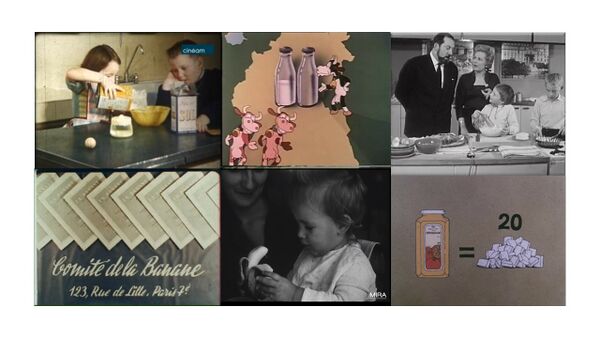
Thèse Amélie Kratz : Au-delà de l'éducation nutritionnelle : l'éducation alimentaire des enfants à travers des audiovisuels en France et en République fédérale d'Allemagne (1950-1980)


